What Is Welding Fume?

Welding fume generation

Although many people think of gases and vapors from gasoline or other chemicals as "fume," technically, fume is comprised of very small, solid particles. Since arc welding usually produces only small concentrations of gases, exposure to gases is seldom a concern except in confined areas. Therefore, the issue of secondary gas production will not be specifically discussed here.

Arc welding creates fume as some of the metal boils from the tip of the electrode and from the surface of molten droplets as they cross the arc. This metal vapor combines with oxygen in the air and solidifies to form tiny fume particles. These particles are visible because of their quantity, but each particle is only between 0.2 and 1.0 micron in size. Since fume primarily comes from the electrode, it consists of oxides of its metals, alloys and flux compounds. In steel welding, therefore, fume is primarily iron oxide and oxides of alloys such as manganese and chromium. With plated or coated metals, some of the fume comes from the weld pool as well. This adds oxides of metals from the base material into the fume such as zinc oxide from welding galvanized steels.

Key Point: Welding fume consists of solid metal oxide particles ranging from 0.2 to 1.0 micron, primarily originating from the electrode but also from base materials.

A Total Systems Approach

There are many ways to reduce exposure to welding fume. Each solution addresses part of the welding system. Each solution, however, has its advantages and disadvantages and should be considered in the context of the total system. The most successful solutions rely on a coordinated effort between managers, engineers, welding supervisors, vendors and especially welders themselves.

Reducing Fume Generation

Methods to minimize the creation of welding fumes at the source.

Limiting Operator Exposure to Fume

Strategies to protect workers from fumes that are generated.

Reducing Fume Generation

Welding Design Considerations

Limiting the generation of welding fume begins at the design stage. Overwelding unnecessarily increases fume. As the amount of weld metal increases, the amount of fume also increases.

Welding Process Selection

Submerged Arc (SAW)

Contains fume under flux blanket. Excellent for flat/horizontal positions.

Gas Tungsten Arc (GTAW)

Very low fume, high skill, low deposition.

Flux Cored (FCAW)

High deposition but larger fume; reduced-fume electrodes available.

Gas Metal Arc (GMAW)

Fume depends on procedure; select lower-manganese wires when possible.

Shielding Gas & Waveform Control

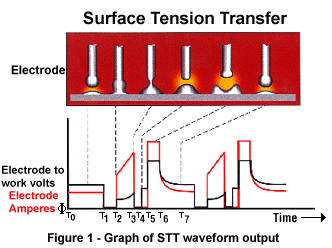
Higher argon blends reduce fume vs 100% CO₂. Pulsed GMAW reduces arc energy and vaporization, lowering fume generation significantly.

Shielding gas cylinder

Limiting Operator Exposure

Job Sharing & Automation

Limit time spent welding by rotating tasks. Automated welding systems reduce direct exposure, though ventilation still required in cells.

Important: Even with robotics, fume extraction remains critical for nearby personnel.

Fume Extraction Technology

Fume extraction arm

Localized ventilation, or fume extraction, is the most effective method. Two main categories:

Low Vacuum / High Volume

Articulated arms (6-9" hoses) move 600-900 CFM. Capture distance 10-15 inches. Requires repositioning, large ductwork.

High Vacuum / Low Volume

Capture at source (within inches). Uses 80-100 CFM, small hoses, integrated fume extraction guns. Higher efficiency, less air makeup.

High vacuum system

High vacuum guns follow the arc automatically, boosting productivity. Cartridge filters achieve 98%+ efficiency without HEPA requirements in most cases.

Advantage: High vacuum systems drastically reduce total airflow (1,200 CFM vs 12,000 CFM for 20 stations) lowering installation and energy costs.

Regulatory Bodies & Exposure Limits

Welding safety

ACGIH sets TLVs (non-enforceable), OSHA sets mandatory PELs (Permissible Exposure Limits). Manganese and chromium have strict 8-hour TWA limits. Overexposure can lead to neurological effects, asthma, or other illnesses.

SubstanceOSHA PEL (8h TWA)ACGIH TLV
Iron Oxide10 mg/m³5 mg/m³
Manganese5 mg/m³ (ceiling)0.1 mg/m³ (respirable)
Chromium (Hexavalent)5 µg/m³0.5 µg/m³

Facilities must conduct breathing-zone sampling. MSDS for electrodes provide detailed fume constituents and exposure guidelines.

Conclusion & Best Practices

  • Adopt a total systems approach: design, process, consumables, ventilation.
  • Use fume extraction (high vacuum guns for mobility, low vacuum arms for fixed stations).
  • Select low-fume consumables and optimized pulsed waveforms.
  • Regularly monitor exposure (OSHA/ACGIH limits).
  • Combine engineering controls with PPE when necessary.
Final Word: No single solution fits all; collaborative efforts between management, engineers and welders deliver the healthiest workplace.

Technical Safety Support

📧 safety@tokoc.com  |  📞 +86 510-8359 5138
Emergency: +86 134-0004-1000 (24h)

ISO 9001 • AWS • CCS • CE

TOKO Group welding consumables comply with global safety standards. MSDS available upon request.